
Water Leak Detection in Gaithersburg, MD: Finding Where the Water Is Going
Some leaks announce themselves with a puddle. Others show up as a number on a water bill, a faint stain, or a smell you cannot place. Gaithersburg Restoration Expert helps owners of homes, condos, and commercial buildings in Gaithersburg, Maryland trace hidden moisture through walls, ceilings, floors, and drain lines. We use moisture meters, thermal imaging, and a pipe camera, so the leak can be found, fixed, and dried before it does more harm.
Call us any hour, 24/7. Estimates are free.
- 24/7 Emergency Calls
- Free Estimates
- Licensed and Insured
Clues That Point to a Hidden Leak
On the Water Bill
A bill that climbs for no reason, with no change in how many people use the water, is one of the earliest signs. Compare a few months of bills to see whether the jump is steady or sudden.
On the Water Meter
If the meter moves when every tap in the building is off, water is going somewhere. This test is explained in the next section.
On Walls, Ceilings, and Floors
Look for stains that spread, paint that bubbles or peels, drywall that feels soft, baseboards that lift, and floors that cup or buckle. A wall that is cooler or damper than the ones beside it deserves a closer look.
By Sound and Smell
A hiss or trickle when nothing is running can mean a supply line is leaking. A musty smell in a room with no visible water often means moisture is trapped behind a surface.
Try the Meter Test First
- Turn off every water-using fixture and appliance, including the washing machine, dishwasher, and ice maker.
- Find your water meter and note the reading, or look for the small leak indicator that many meters have.
- Wait at least 15 to 30 minutes without using any water.
- Check the meter again. If the reading changed or the indicator is moving, water is leaking somewhere.
If the meter stays still, the problem may be a leak that only runs at certain times, such as when a fixture is in use, or water that is coming from outside, such as a roof.
Which Part of the Building Is Leaking?
The timing of the problem narrows down the source.
- Only after rain or snowmelt: think roof, flashing, windows, or the ground outside. A roof leak is a different kind of repair, and a roofer handles it.
- Only when a fixture is used: think drain, trap, or shower pan.
- All the time: think supply line, a fitting, or an appliance connection.
- In a closet or utility room: check the water heater, washing machine hoses, and HVAC drain pan.
The Tools We Use to Trace Hidden Water
Moisture Meters Map the Wet and the Dry
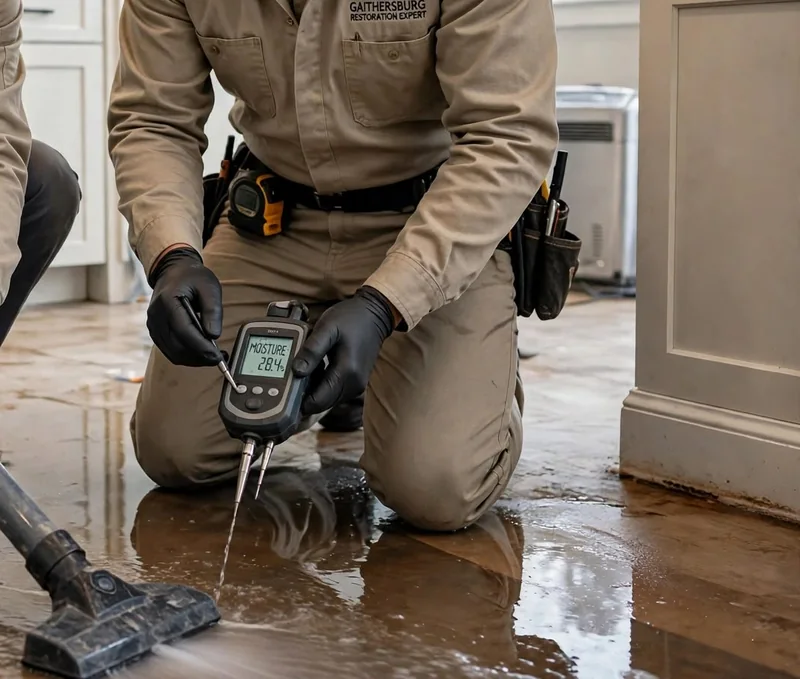
We scan walls, floors, and ceilings with moisture meters and compare them with dry areas. This shows the shape of the damp area and where it is strongest.
Thermal Imaging Shows Temperature Differences
A thermal camera picks up surface temperature differences without opening anything. A wet area often reads cooler than the dry material around it, so it can point us to places worth checking. We confirm what we see with a moisture meter, because temperature alone does not prove that something is wet.
A Pipe Camera Looks Inside Drain Lines
When the problem may be in a drain or sewer line, a small camera on a flexible cable can be fed into the pipe. It lets us see cracks, blockages, roots, and sagging sections instead of guessing. It is an inspection tool, not a repair, and it does not dig anything up.
Following the Trail and Writing It Down
Water travels. By tracing readings outward from the stain, we narrow down where it entered, which gives a plumber a place to start. We document what we find so your plumber and your insurer have the same information. We do not open walls without telling you why.
What Our Tools Cannot Do
Meters and thermal images find wet or cooler materials. A pipe camera shows the inside of a drain. None of them replaces a plumber, who confirms the source and repairs it. We work with your plumber, and we can start drying once the leak is stopped.
Hidden Leaks in Condos and Townhomes
Water in a wall or ceiling may belong to another unit, to a shared pipe, or to the building's roof. If you see stains on a shared wall or ceiling, tell your association or property manager, and keep dated photos. Our moisture readings help show where the water is and how far it has traveled.
Why a Small Leak Is Worth Chasing
A slow leak can keep wood, drywall, and insulation damp for months. That can lead to rot, swollen materials, and mold. The EPA says moisture control is the key to mold control, so finding a leak early limits the damage. Our mold remediation page explains what happens if mold has already started.
After the Leak Is Found
The plumber stops the leak. Then wet materials need to be dried, and anything that cannot be saved needs to be removed. If the leak was a pipe that split, our burst pipe water damage page covers that work. Drying is explained on our structural drying and dehumidification page.
Insurance and Slow Leaks
Policies often cover sudden leaks but exclude damage from long-term seepage or poor maintenance. Check your policy and ask your insurer what applies. We offer insurance claim assistance and can tell you what readings and photos to keep. Good records help, but they cannot guarantee a payout.
Water Leak Detection Across 20878, 20877, 20886, and Nearby ZIP Codes
We help trace hidden leaks across Gaithersburg, including 20878, 20877, 20886, and 20879, and in nearby communities such as Germantown, Derwood, and Rockville. Give us your address so we can confirm that your property is in our service area. The areas we serve page shows where else we work.
Ask Us About a Suspected Leak
Tell us what you have noticed, how long it has been going on, and what the meter test showed. We will talk through what to do next and give you a free estimate.